|
Sparrowhawk photo by
Bence Mate courtesy of
www.hidephotography.com
reposted with permission. |
|
How do ideas come to life? A deceptively simple question that has no concrete answer. In my work, inspiration comes in many different forms. It can be the shape of a tree sillouhetted against a setting sun, the way the light plays off the iridescence of the local magpies and ravens, the simple complexity of a fern or horsetail growing in the deep, cool boreal forest, or the flash of a predator's eyes as it stops for a refreshing drink.
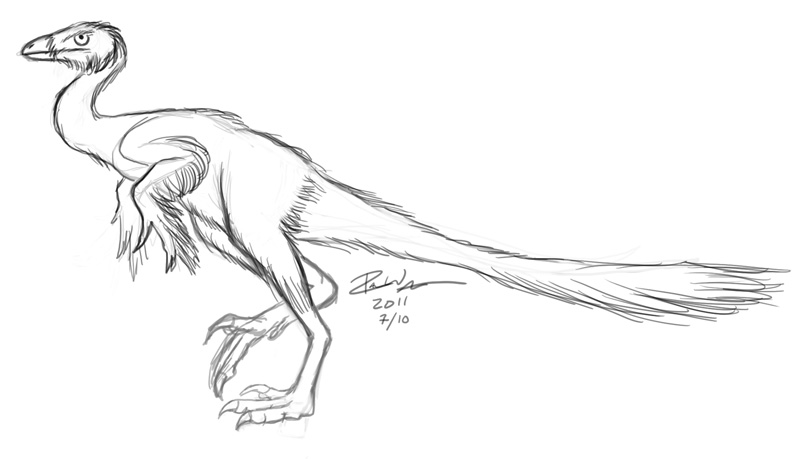
When creating something that only exists in one's imagination, it is important to keep at least part of the work grounded in reality. In the case of the painting "Troodon in the Rushes," I spent many hours researching not only the visual aspects of the work - art nouveau styles, iridescent bird feathers, and so on - but also the scientific aspects of paleoecology, paleobotany, and paleobiology.
What was the habitat of
Troodon formosus? Where could it be found? The evidence for Troodon in the Alaskan fossil record is scant and scrappy - a few teeth
1, 2 and a couple partial braincases
3 are the only testament to their occupation of far northern climes during the Late Cretaceous (between 70 million and 69 million years ago). Thankfully, more complete specimens have turned up in other locations such as Alberta, Canada and even as far south as Wyoming.
Reconstructing ancient ecosystems is not just limited to animal life - to create a realistic setting, one must also become aquainted with the flora of a particular locale or geologic epoch. During the Late Cretaceous, ferns and horsetails were very common, filling niches that are claimed by grasses and flowering plants today. Balmier temperatures in Alaska also meant that warm weather trees, such as gingko, proliferated quite nicely under the ancient Midnight Sun
4.
I would like to take this time to thank paleontologist
Scott Hartman for the use of his skeletal reconstruction (and for taking time out of his busy schedule of being a "Force ghost" on the new Discovery Channel mini-series
Dinosaur Revolution to critique my work), as well as Bence Máté and Boglárka Somfalvi of
Hide Photography for allowing the sparrowhawk photo above to be used as reference.
REFERENCES:
Aside from the obligatory use of Wikipedia, I also used the following source material:
1.
Fiorillo,
Anthony R.; Gangloff, Roland A. (2000). "Theropod teeth from the Prince
Creek Formation (Cretaceous) of Northern Alaska, with speculations on
Arctic dinosaur paleoecology". Journal of Vertebrate Paleontology 20 (4): 675–682
2. Fiorillo, Anthony R. (2008) "On the Occurrence of Exceptionally Large Teeth of
Troodon (Dinosauria: Saurischia) from the Late Cretaceous of Northern Alaska" Palaios volume 23 pp.322-328
3. Fiorillo, Anthony R.; Tykoski, Ronald S.; Currie, Philip J.; McCarthy, Paul J.; Flaig, Peter. (2009) "Description of Two Partial Troodon Braincases from the Prince Creek Formation (Upper Cretaceous), North Slope Alaska". Journal of Vertebrate Paleontology 29(1):178-187
4. Knowlton, Frank H.; La Motte, Robert S. (
1919)
A catalogue of Mesozoic and Cenozoic plants of North America
If you are interested in purchasing prints, visit my DeviantArt page.